


We use the second conditional to talk about hypothetical or imaginary situations in the present or future.
In the if-clause we use simple past or past continuous.
In the other clause (consequence/result), we can use would, could or might.

For the verb be, we usually start our sentence with If + subject + were
For examples:
If I were rich, I’d buy a Ferrari
If he were/ was rich, he’d buy a Porsche.
When we want to give advice, we always use If I were …
Examples:
If I were you, I wouldn’t go there.
If I were you, I’d travel to Brazil instead of Australia.


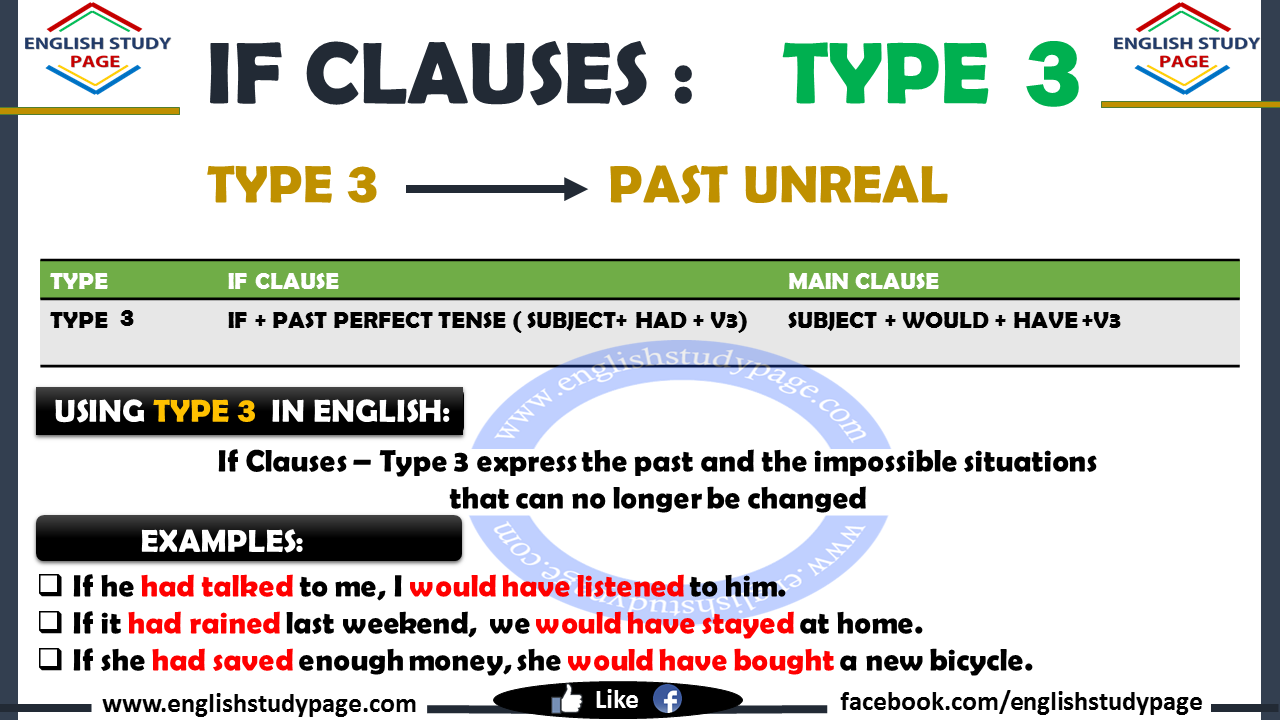
Condition | Result | |
Past Perfect | WOULD HAVE + Past Participle | |
If | I had won the lottery | I would have bought a car. |
IF | Condition | Result |
past perfect | WOULD HAVE + past participle | |
If | I had seen Mary | I would have told her. |
If | Tara had been free yesterday | I would have invited her. |
If | they had not passed their exam | their teacher would have been sad. |
If | it had rained yesterday | would you have stayed at home? |
If | it had rained yesterday | what would you have done? |
Result | IF | Condition |
WOULD HAVE + past participle | past perfect | |
I would have told Mary | if | I had seen her. |
I would have invited Tara | if | she had been free yesterday. |
Their teacher would have been sad | if | they had not passed their exam. |
Would you have stayed at home | if | it had rained yesterday? |
What would you have done | if | it had rained yesterday? |
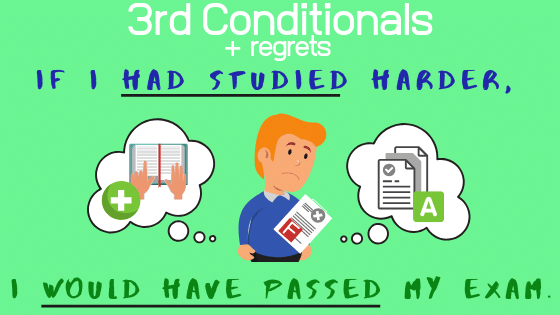
If I had studied harder, I would have passed my exam.
[condition] [result]
Here, the speaker could have studied harder and the result could have been passing his exam, but in reality, they didn’t study so much and they didn’t pass. It is too late for this condition to become true.
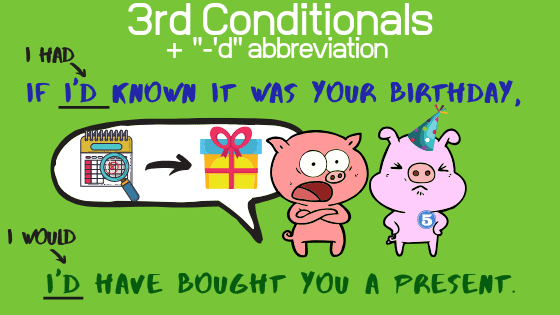
Note: In English, we often abbreviate words especially when speaking casually. Both the words “would” and “had” can be abbreviated to “- ‘d” ( apostrophe + “d” ). This can be confusing when it occurs in the 3rd conditional which uses both words in the same sentence. To help you decide which word “- ‘d” is referring to, remember that:
For example:
(I had) (I would)
If I’d known it was your birthday, I’d have bought you a present.
[condition] [result]
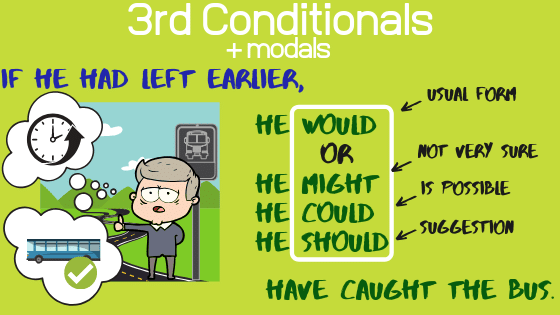
Note: It is possible to use other modals such as “could,” “might,” and “should” in
place of “would” in the 3rd conditional as well. Changing the modal
changes the degree of certainty, with “might” being not very sure,
“could” being about 50/50 and “should” being very sure. For example:
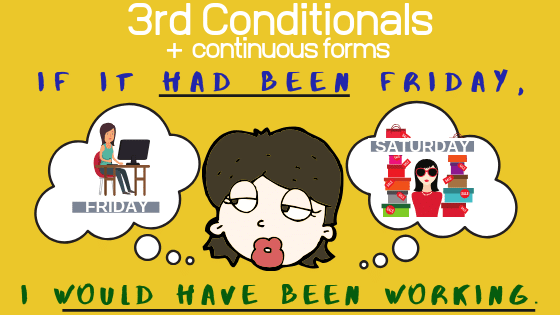
Note: The continuous form can also be used in the 3rd conditional to talk about unfinished or continuous actions /states that would have resulted in the past, from possible past conditions that didn’t actually happen. The structure is the same in the condition part with “If” followed by the past perfect, while the result part takes “would” followed by the present perfect continuous form:
[If + past perfect tense] , + [would + have been verb-ing]
[condition] [result]
OR
[would + have been verb-ing] (no comma) + [If + past perfect tense]
[result] [condition]
For example:

To form the zero conditional structure formed we use the present tense in both
the condition and result part of the sentence. As mentioned before, these parts
can be arranged with either the condition coming first and the result second, or
the result coming first and the condition second:

Using “When” instead of “If” in zero conditionals
Note: Since zero conditionals describe general truths, things that happen all
the time, you can also use “when” instead of “If” in the condition part of the
sentence, with the meaning remaining the same.
For example :
If the temperature is 0°C, it snows.
[condition] [result]
Has the same meaning as:
When the temperature is 0°C, it snows.
[condition] [result]

Zero conditional structures are used to talk about results that happen depending on the conditional or “if” clause. Sometimes we need to change the certainty of the second action with an adverb of frequency.
Here are some examples:
If it rains, I always take an umbrella
When the sun shines in Spain, the weather is usually hot.
I never take the train if the busses are running on time.
When I find a good series on Netflix, I often binge watch all weekend!

